The Call of the Void 2026
There has always been a troubling depth to Gilles Teboul's paintings.
Something fatal. At once seductive—and ominous.
Something one cannot escape, yet will never truly encounter.
I am not speaking of that sublime make-up red, where one cannot tell whether the carmine is gently dissolving into crimson, or stoically waiting for the violet to encroach upon it through capillary action.
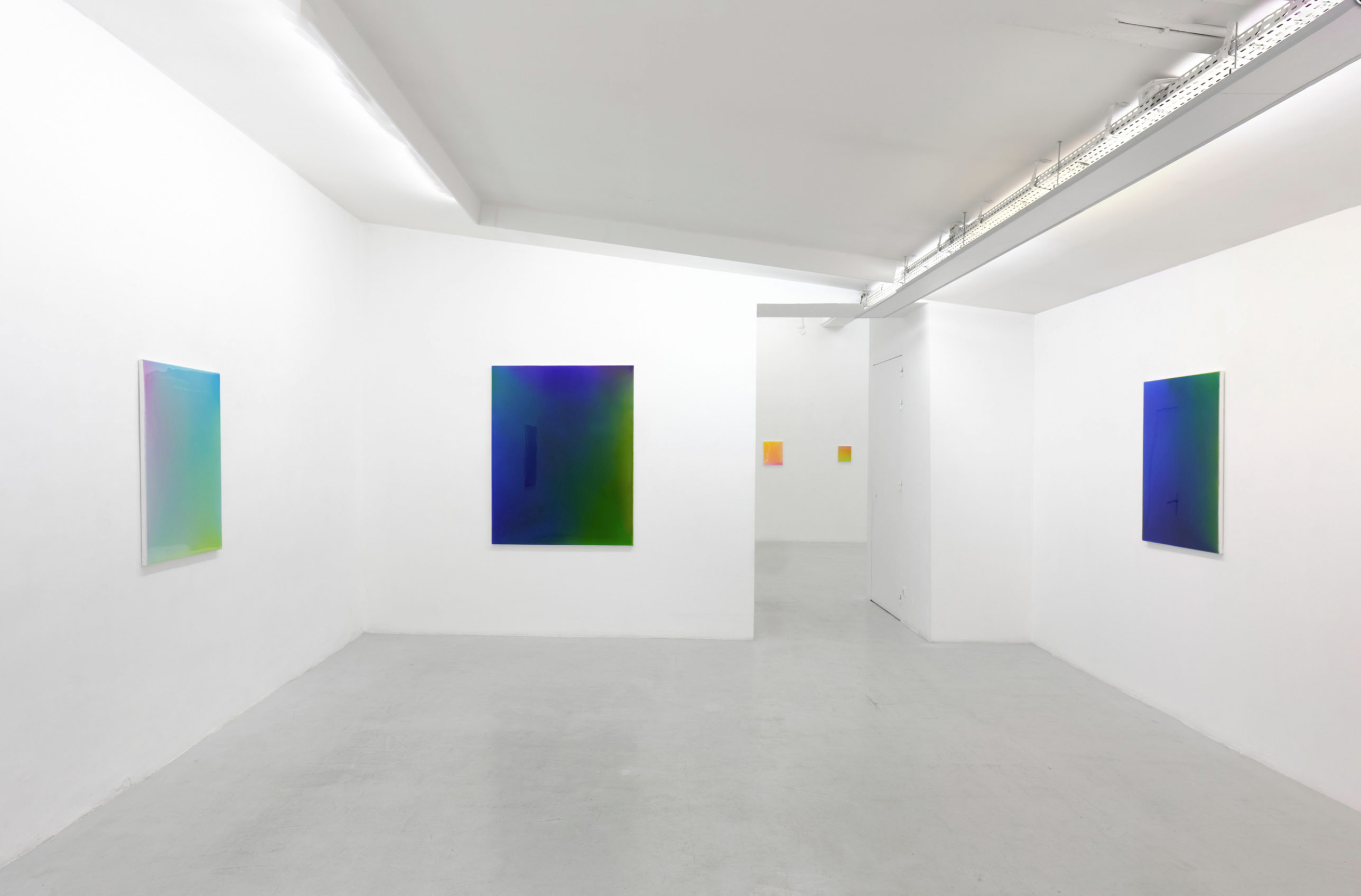
I am thinking instead of those dark greens with their infinitesimal variations, a tremor deep within a wood, almost imperceptible, and of the unconscious fears that rise to the glossy surface of the resin, making their way to the edge of the canvas, where flashes of white offer glimpses of what consciousness represses—the predation lurking there. I remember those dark blues or, on the contrary, those bathed in light—so many degrees of immersion. I am certain you have felt it too: that vague unease that takes hold, that shift in tone, from the paradisiacal to the amniotic. Perhaps you too, faced with these fragments of infinity, have felt, for an instant, submerged?
Something of vertigo.
A dizziness.
A disturbance of the vestibular system.
The inner ear loses its bearings; the eye can no longer find its point of equilibrium.
And then
—the call of the void.
Make no mistake. Even when adorned with more acidic hues, Gilles Teboul's reflective surfaces operate in darkness. A turquoise, a salmon, a lemon? A Californian sunset? Pop introduces its shrillness. A glitch in contemplation.
A state of suspension—necessarily ambiguous.
Gilles Teboul's paintings function as contemporary vanitas. Their formal seduction, which the artist conceives as a lure, becomes a trap for the gaze. They tell me: you are here. They tell me: you are already vanishing.
I am reminded of Roland Barthes's famous "that-has-been" in Camera Lucida.
"[...] photography tells me death in the future," he writes.
Gilles Teboul's paintings have much to do with photography.
Did you know that the artist also practises it?
I mean: elsewhere than in his painting.
He has always used it in a way that might be described as conceptual.
Through photography, he inventories, archives.
It is the memory of the studio. No, not memory. Memory is too forgetful. Its record. Methodically, always following the same procedure, Gilles Teboul photographs his tools, the residue left at the bottom of his pots, failed canvases, folded canvases. Remains. Against a white, neutral, almost clinical background.
These photographs remain at the periphery.
Yet they inform the artist's practice.
They invoke this relationship to death.
Gilles Teboul's paintings have much to do with the photographic.
The presence of absence, chemistry.
For several years now, pursuing his "distancing of the painter's gesture," Gilles Teboul has been developing series of paintings in which he goes so far as to "abolish all gestural involvement" (to quote him precisely). To do so, he pours one or several coloured resins directly onto paintings laid flat on supports, without intervening in the way they spread. Gravity gradually does its work. At this stage, the pictorial layer is opaque, milky. One must wait patiently for the acrylic binder to dry before the revelation can occur.
Something expands, then sets. The image appears. Only to disappear: raised upright, exhibited, it asserts itself and withdraws in the very same movement. A mental image. Powerfully present, almost monolithic, yet paradoxically eluding apprehension: the gaze loses itself within it, simultaneously seeking and avoiding an encounter with the surrounding space and with itself. I think of the Californian Minimalists. John McCracken. On the other side of the ocean, closer to us: Art & Language, too. Michael Baldwin's Mirror Piece (1965). I think of the cinema of the 1960s and 1970s, of crime scenes glimpsed in reflections, at the edges of the plot, of complicit glass vestibules. But mentally I sweep aside all these echoes of an overwhelmingly masculine universe—one that Gilles Teboul, for his part, has been patiently deconstructing for years.
Gilles Teboul's paintings have much to do with the image.
The one that cannot be seen.
The one that obsesses, that fascinates, the one the "forbidden gaze" cannot reach—to twist Max Milner (On est prié de fermer les yeux)—the one that vitrifies, holding us at a distance while keeping us, always and irrevocably, within the field. The one that must perhaps be approached obliquely.
Gilles Teboul's paintings make me believe in their frontality, so thoroughly pictorial.
They tell me: you are the subject.
But they look at me obliquely. Where vision sharpens.
There has always been a troubling depth to Gilles Teboul's paintings.
Something fatal. At once seductive—and ominous.
Something one cannot escape, yet will never truly encounter.
I am not speaking of that sublime make-up red, where one cannot tell whether the carmine is gently dissolving into crimson, or stoically waiting for the violet to encroach upon it through capillary action.
I am thinking instead of those dark greens with their infinitesimal variations, a tremor deep within a wood, almost imperceptible, and of the unconscious fears that rise to the glossy surface of the resin, making their way to the edge of the canvas, where flashes of white offer glimpses of what consciousness represses—the predation lurking there. I remember those dark blues or, on the contrary, those bathed in light—so many degrees of immersion. I am certain you have felt it too: that vague unease that takes hold, that shift in tone, from the paradisiacal to the amniotic. Perhaps you too, faced with these fragments of infinity, have felt, for an instant, submerged?
Something of vertigo.
A dizziness.
A disturbance of the vestibular system.
The inner ear loses its bearings; the eye can no longer find its point of equilibrium.
And then
—the call of the void.
Make no mistake. Even when adorned with more acidic hues, Gilles Teboul's reflective surfaces operate in darkness. A turquoise, a salmon, a lemon? A Californian sunset? Pop introduces its shrillness. A glitch in contemplation.
A state of suspension—necessarily ambiguous.
Gilles Teboul's paintings function as contemporary vanitas. Their formal seduction, which the artist conceives as a lure, becomes a trap for the gaze. They tell me: you are here. They tell me: you are already vanishing.
I am reminded of Roland Barthes's famous "that-has-been" in Camera Lucida.
"[...] photography tells me death in the future," he writes.
Gilles Teboul's paintings have much to do with photography.
Did you know that the artist also practises it?
I mean: elsewhere than in his painting.
He has always used it in a way that might be described as conceptual.
Through photography, he inventories, archives.
It is the memory of the studio. No, not memory. Memory is too forgetful. Its record. Methodically, always following the same procedure, Gilles Teboul photographs his tools, the residue left at the bottom of his pots, failed canvases, folded canvases. Remains. Against a white, neutral, almost clinical background.
These photographs remain at the periphery.
Yet they inform the artist's practice.
They invoke this relationship to death.
Gilles Teboul's paintings have much to do with the photographic.
The presence of absence, chemistry.
For several years now, pursuing his "distancing of the painter's gesture," Gilles Teboul has been developing series of paintings in which he goes so far as to "abolish all gestural involvement" (to quote him precisely). To do so, he pours one or several coloured resins directly onto paintings laid flat on supports, without intervening in the way they spread. Gravity gradually does its work. At this stage, the pictorial layer is opaque, milky. One must wait patiently for the acrylic binder to dry before the revelation can occur.
Something expands, then sets. The image appears. Only to disappear: raised upright, exhibited, it asserts itself and withdraws in the very same movement. A mental image. Powerfully present, almost monolithic, yet paradoxically eluding apprehension: the gaze loses itself within it, simultaneously seeking and avoiding an encounter with the surrounding space and with itself. I think of the Californian Minimalists. John McCracken. On the other side of the ocean, closer to us: Art & Language, too. Michael Baldwin's Mirror Piece (1965). I think of the cinema of the 1960s and 1970s, of crime scenes glimpsed in reflections, at the edges of the plot, of complicit glass vestibules. But mentally I sweep aside all these echoes of an overwhelmingly masculine universe—one that Gilles Teboul, for his part, has been patiently deconstructing for years.
Gilles Teboul's paintings have much to do with the image.
The one that cannot be seen.
The one that obsesses, that fascinates, the one the "forbidden gaze" cannot reach—to twist Max Milner (On est prié de fermer les yeux)—the one that vitrifies, holding us at a distance while keeping us, always and irrevocably, within the field. The one that must perhaps be approached obliquely.
Gilles Teboul's paintings make me believe in their frontality, so thoroughly pictorial.
They tell me: you are the subject.
But they look at me obliquely. Where vision sharpens.