The Mystery and Misery of Painting 2026
The kind-hearted servant of whom you were jealous,
And who sleeps her sleep beneath a humble lawn,
We should nevertheless bring her a few flowers.
Charles Baudelaire
There is no idea more tenacious in France than that of the death of painting. Does this come to us solely from the avant-gardes, and from the prescriptive interpretation our public institutions may have made of them? Or does it stem from Baudelaire’s nevertheless reassuring remark to Manet—“You are only the first in the decrepitude of your art” (i.e., there is no point taking people’s mockery to heart; it will no more kill you than it did Wagner or Chateaubriand…)? One might say that, for several generations of painters, this idea has been experienced as a consummate fantasy, one that naturally called for evidence to lend it substance: a case file, experiments, personal experiences, certified testimonies.
Gilles Teboul, too, began there—by which I mean with a kind of inhibition, an impediment to devoting himself to a practice that no longer offered any vital guarantee. That was a long time ago, and one might declare the statute of limitations expired on his lament for the death of the Beautiful, were some trace of it not still present in the title of his latest exhibition at Galerie Richard: “What would we be without the help of what does not exist?” The phrase is Valéry’s. It proves that we should never despair of poets: they always manage to pull us out of the ruts into which we thought they had led us…
Teboul found his own way out, and we know how. As early as the end of the last century, taking stock of the great Catastrophe, he decided to photograph the instruments of the deceased activity. In other words, he erected his own Monument to Painting, fixing onto photosensitive paper the bottoms of paint pots and brushes, gloves, rags, canvases unstapled and taped down, dirty palettes and crushed tubes—all the discarded supports and tools strewn about the studio.¹ This distancing hit its mark, yet it was not enough to overcome a more intimate resistance.
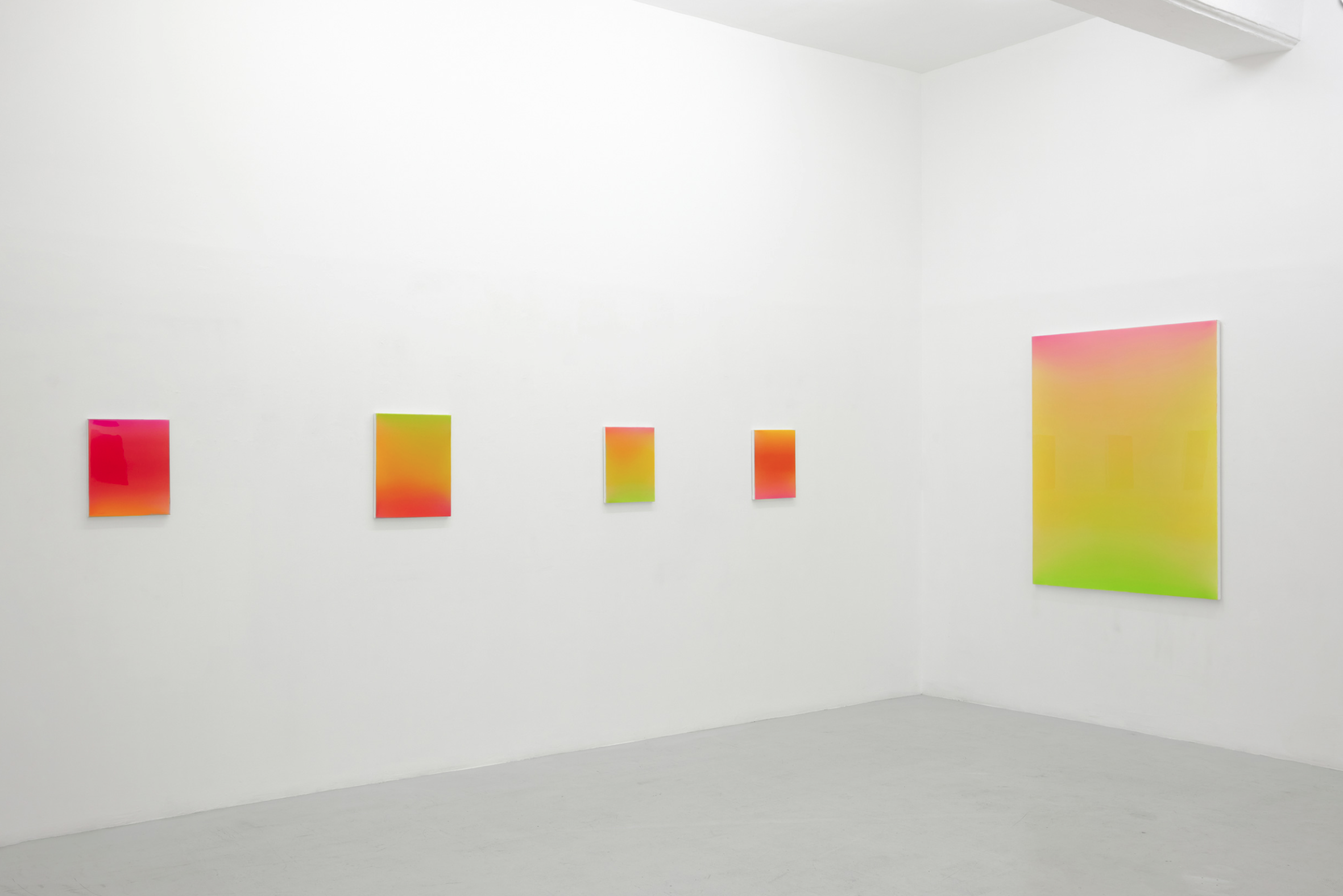
Beginning in 2016, the artist repeated the gesture in another form. He laid his stretchers on the floor and covered them with layers of opaque resin into which he incorporated pigments: the heavy, shifting material “takes on a life of its own” across the canvases, the color sinking through the resin, the two migrating unpredictably over the more or less stable plane. Only after two days, once the resins have become transparent as they dry, do the colors emerge—pure or blended, deep or light, dense or evanescent. Depending on what appears, Teboul begins again, superimposing another layer.
The process is simple; what it reveals is far less so. For in this temporal passage from opacity to transparency, a kind of suspense arises between an initial depth and a subsequent “superficiality”; or again, as the painting moves from the horizontality of the floor to the verticality of the wall, between an unfathomable invisibility—of a bodily order—and an exclusively optical revelation.²
The self-generating process of painting that Teboul has devised lies at the juncture of these polarities of color, seeking alternately to associate it with, or dissociate it from, that which binds it—the supporting resin—or releases it: light. The sometimes numerous layers of resin create uneven thicknesses that hold back or accommodate the color. At times, pigmentary intensities efface the support altogether, producing pure monochromes—which might be compared to the flat fields of Pop Art—or even bursts of light in which the hue, already intense in itself, tips over into unreality.
In the latter case, the dazzled viewer clings to some fragment of the surrounding context glimpsed in the mirror-like painting, resisting the dissolution of the visible. The recent paintings push these contradictory tensions to their utmost: tensions born, on the one hand, of the struggle between light and color and, on the other, between color and matter.
What, then, do Gilles Teboul’s paintings confront us with? An internal strangeness. The mystery that inhabits them lies in the fact that their unity is artificial, their harmony deceptive. These are, in fact, paintings in which color stands for something seeking to escape, yet utterly unable to do so. As for the substrate, it seems undermined by some elsewhere, by an uncontrollable element that remains, again and again, the artist’s jouissance—between assurance and betrayal, proximity and absence.
Call it light, if you will, but it is the play within it and beyond it that engages the viewer—and enrages them if they refuse to admit that they have been taken in, the sorry dupe of the game.
There can be no doubt that if Teboul’s work constitutes an attempt to deconstruct painting, it cannot do so by simplifying its coordinates. The effort of letting go that one senses here is neither an idea nor a pose. With as much nerve as method, as much fascination as jubilation, he seeks to clear the table, only to encounter the impossibility of ejecting from it precisely that which refuses to adhere.
Such are these new mysteries of painting, which Gilles Teboul has fashioned, for a Sleeping Beauty, as a charming offering to Galerie Richard!
1 Roland Barthes told us that photography is the substitute for the monuments of old: it preserves evidence of the real existence of what has been. The maneuver, full of cunning, works perfectly for Gilles Teboul: the formats of his images, the angles of view, the details—everything in his photographs bears witness to that which, having lived, lives on. Variously printed, the cadavre exquis of an interrupted practice preserves traces, imprints, scratches, cuts, abstract signs: the ghost of painting survives in a kind of inverted pareidolia, the product of the imagination of a modern-day Leonardo. Teboul the photographer was, after all, still a painter.
2 Photography has led us to a dual conception of the relationship between light and color. Something like: more light = more color. Yet in painting—and this has always been so—color is subordinate to the properties of the material in which it is embedded. And since that material may diffract or absorb light, color occupies, between the two, a position one might describe as that of the "excluded third": as pigment, it is made a vassal of the materials that receive it, even if its chemistry allows it a certain freedom from whatever would seek to hold it back. For it is its marriage with rays of light that opens onto the promise of an existence of its own.
The kind-hearted servant of whom you were jealous,
And who sleeps her sleep beneath a humble lawn,
We should nevertheless bring her a few flowers.
Charles Baudelaire
There is no idea more tenacious in France than that of the death of painting. Does this come to us solely from the avant-gardes, and from the prescriptive interpretation our public institutions may have made of them? Or does it stem from Baudelaire’s nevertheless reassuring remark to Manet—“You are only the first in the decrepitude of your art” (i.e., there is no point taking people’s mockery to heart; it will no more kill you than it did Wagner or Chateaubriand…)? One might say that, for several generations of painters, this idea has been experienced as a consummate fantasy, one that naturally called for evidence to lend it substance: a case file, experiments, personal experiences, certified testimonies.
Gilles Teboul, too, began there—by which I mean with a kind of inhibition, an impediment to devoting himself to a practice that no longer offered any vital guarantee. That was a long time ago, and one might declare the statute of limitations expired on his lament for the death of the Beautiful, were some trace of it not still present in the title of his latest exhibition at Galerie Richard: “What would we be without the help of what does not exist?” The phrase is Valéry’s. It proves that we should never despair of poets: they always manage to pull us out of the ruts into which we thought they had led us…
Teboul found his own way out, and we know how. As early as the end of the last century, taking stock of the great Catastrophe, he decided to photograph the instruments of the deceased activity. In other words, he erected his own Monument to Painting, fixing onto photosensitive paper the bottoms of paint pots and brushes, gloves, rags, canvases unstapled and taped down, dirty palettes and crushed tubes—all the discarded supports and tools strewn about the studio.¹ This distancing hit its mark, yet it was not enough to overcome a more intimate resistance.
Beginning in 2016, the artist repeated the gesture in another form. He laid his stretchers on the floor and covered them with layers of opaque resin into which he incorporated pigments: the heavy, shifting material “takes on a life of its own” across the canvases, the color sinking through the resin, the two migrating unpredictably over the more or less stable plane. Only after two days, once the resins have become transparent as they dry, do the colors emerge—pure or blended, deep or light, dense or evanescent. Depending on what appears, Teboul begins again, superimposing another layer.
The process is simple; what it reveals is far less so. For in this temporal passage from opacity to transparency, a kind of suspense arises between an initial depth and a subsequent “superficiality”; or again, as the painting moves from the horizontality of the floor to the verticality of the wall, between an unfathomable invisibility—of a bodily order—and an exclusively optical revelation.²
The self-generating process of painting that Teboul has devised lies at the juncture of these polarities of color, seeking alternately to associate it with, or dissociate it from, that which binds it—the supporting resin—or releases it: light. The sometimes numerous layers of resin create uneven thicknesses that hold back or accommodate the color. At times, pigmentary intensities efface the support altogether, producing pure monochromes—which might be compared to the flat fields of Pop Art—or even bursts of light in which the hue, already intense in itself, tips over into unreality.
In the latter case, the dazzled viewer clings to some fragment of the surrounding context glimpsed in the mirror-like painting, resisting the dissolution of the visible. The recent paintings push these contradictory tensions to their utmost: tensions born, on the one hand, of the struggle between light and color and, on the other, between color and matter.
What, then, do Gilles Teboul’s paintings confront us with? An internal strangeness. The mystery that inhabits them lies in the fact that their unity is artificial, their harmony deceptive. These are, in fact, paintings in which color stands for something seeking to escape, yet utterly unable to do so. As for the substrate, it seems undermined by some elsewhere, by an uncontrollable element that remains, again and again, the artist’s jouissance—between assurance and betrayal, proximity and absence.
Call it light, if you will, but it is the play within it and beyond it that engages the viewer—and enrages them if they refuse to admit that they have been taken in, the sorry dupe of the game.
There can be no doubt that if Teboul’s work constitutes an attempt to deconstruct painting, it cannot do so by simplifying its coordinates. The effort of letting go that one senses here is neither an idea nor a pose. With as much nerve as method, as much fascination as jubilation, he seeks to clear the table, only to encounter the impossibility of ejecting from it precisely that which refuses to adhere.
Such are these new mysteries of painting, which Gilles Teboul has fashioned, for a Sleeping Beauty, as a charming offering to Galerie Richard!
1 Roland Barthes told us that photography is the substitute for the monuments of old: it preserves evidence of the real existence of what has been. The maneuver, full of cunning, works perfectly for Gilles Teboul: the formats of his images, the angles of view, the details—everything in his photographs bears witness to that which, having lived, lives on. Variously printed, the cadavre exquis of an interrupted practice preserves traces, imprints, scratches, cuts, abstract signs: the ghost of painting survives in a kind of inverted pareidolia, the product of the imagination of a modern-day Leonardo. Teboul the photographer was, after all, still a painter.
2 Photography has led us to a dual conception of the relationship between light and color. Something like: more light = more color. Yet in painting—and this has always been so—color is subordinate to the properties of the material in which it is embedded. And since that material may diffract or absorb light, color occupies, between the two, a position one might describe as that of the "excluded third": as pigment, it is made a vassal of the materials that receive it, even if its chemistry allows it a certain freedom from whatever would seek to hold it back. For it is its marriage with rays of light that opens onto the promise of an existence of its own.