Texts
The Call of the Void 2026
There has always been a troubling depth to Gilles Teboul's paintings.Something fatal. At once seductive—and ominous.Something one cannot escape, yet will never truly encounter. I am not speaking of that sublime make-up red, where one cannot tell whether the carmine is gently dissolving into crimson, or stoically waiting for the violet to encroach upon it through capillary action. I am...
There has always been a troubling depth to Gilles Teboul's paintings.
Something fatal. At once seductive—and ominous.
Something one cannot escape, yet will never truly encounter.
I am not speaking of that sublime make-up red, where one cannot tell whether the carmine is gently dissolving into crimson, or stoically waiting for the violet to encroach upon it through capillary action.
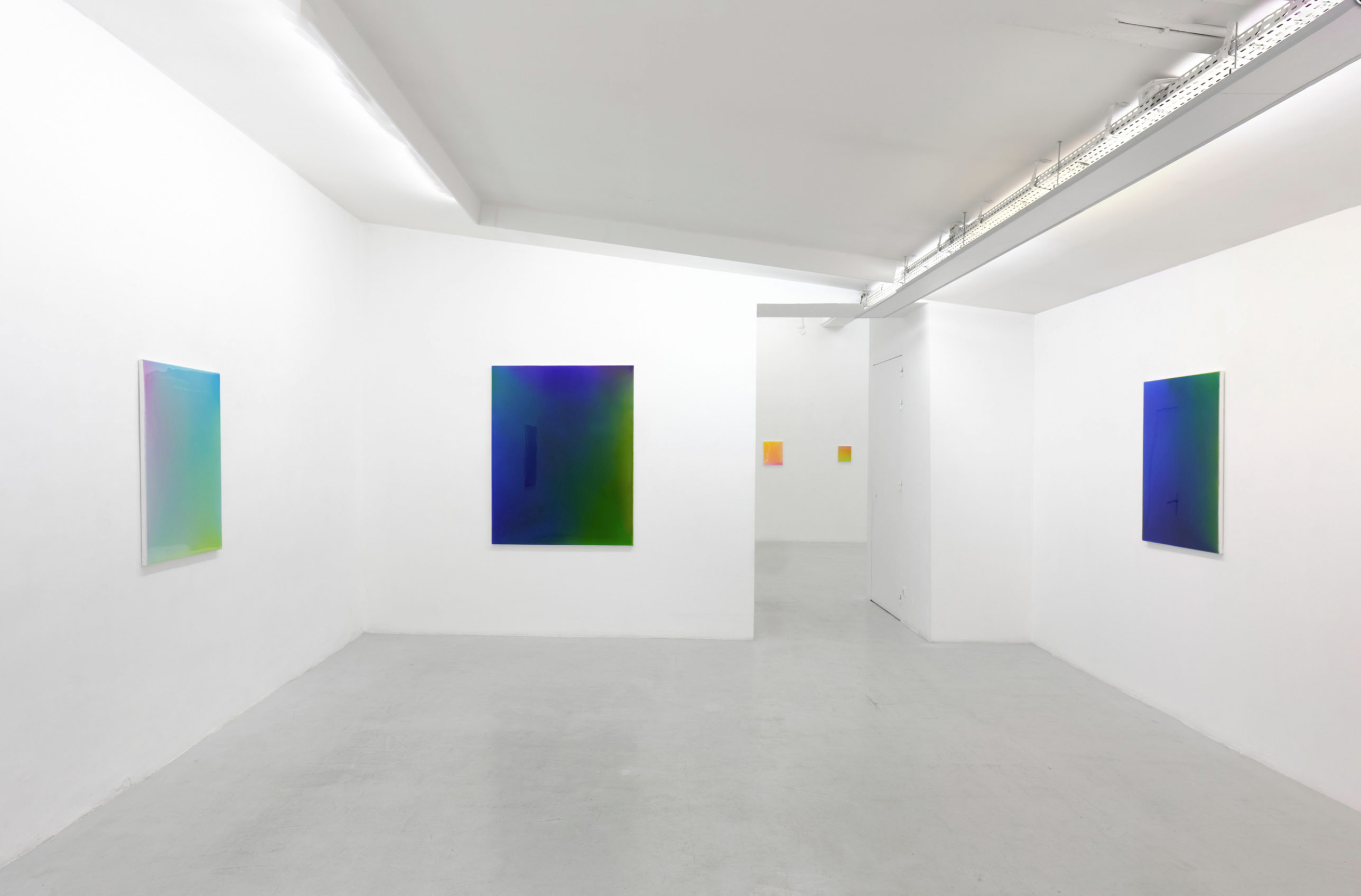
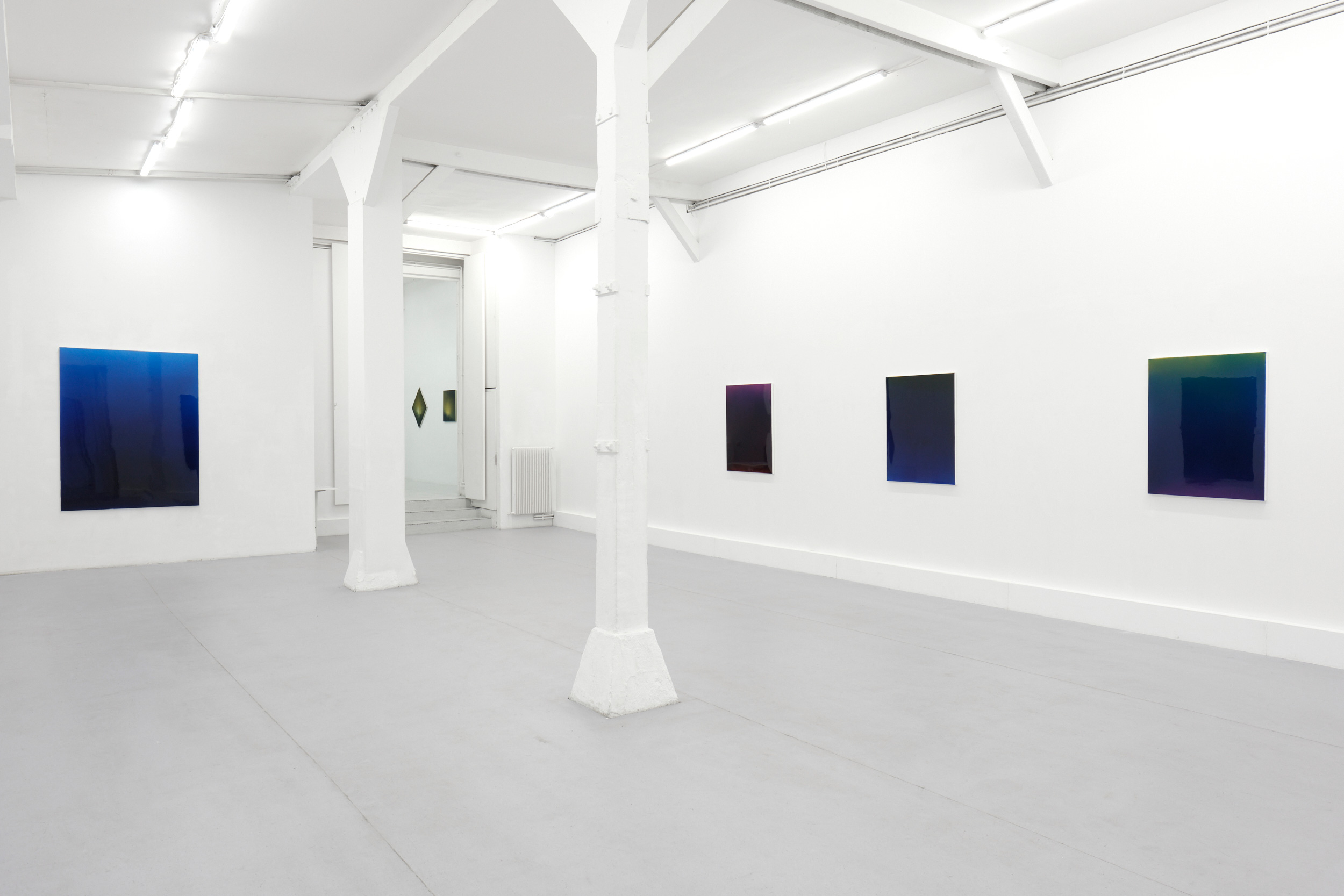
I am thinking instead of those dark greens with their infinitesimal variations, a tremor deep within a wood, almost imperceptible, and of the unconscious fears that rise to the glossy surface of the resin, making their way to the edge of the canvas, where flashes of white offer glimpses of what consciousness represses—the predation lurking there. I remember those dark blues or, on the contrary, those bathed in light—so many degrees of immersion. I am certain you have felt it too: that vague unease that takes hold, that shift in tone, from the paradisiacal to the amniotic. Perhaps you too, faced with these fragments of infinity, have felt, for an instant, submerged?
Something of vertigo.
A dizziness.
A disturbance of the vestibular system.
The inner ear loses its bearings; the eye can no longer find its point of equilibrium.
And then
—the call of the void.
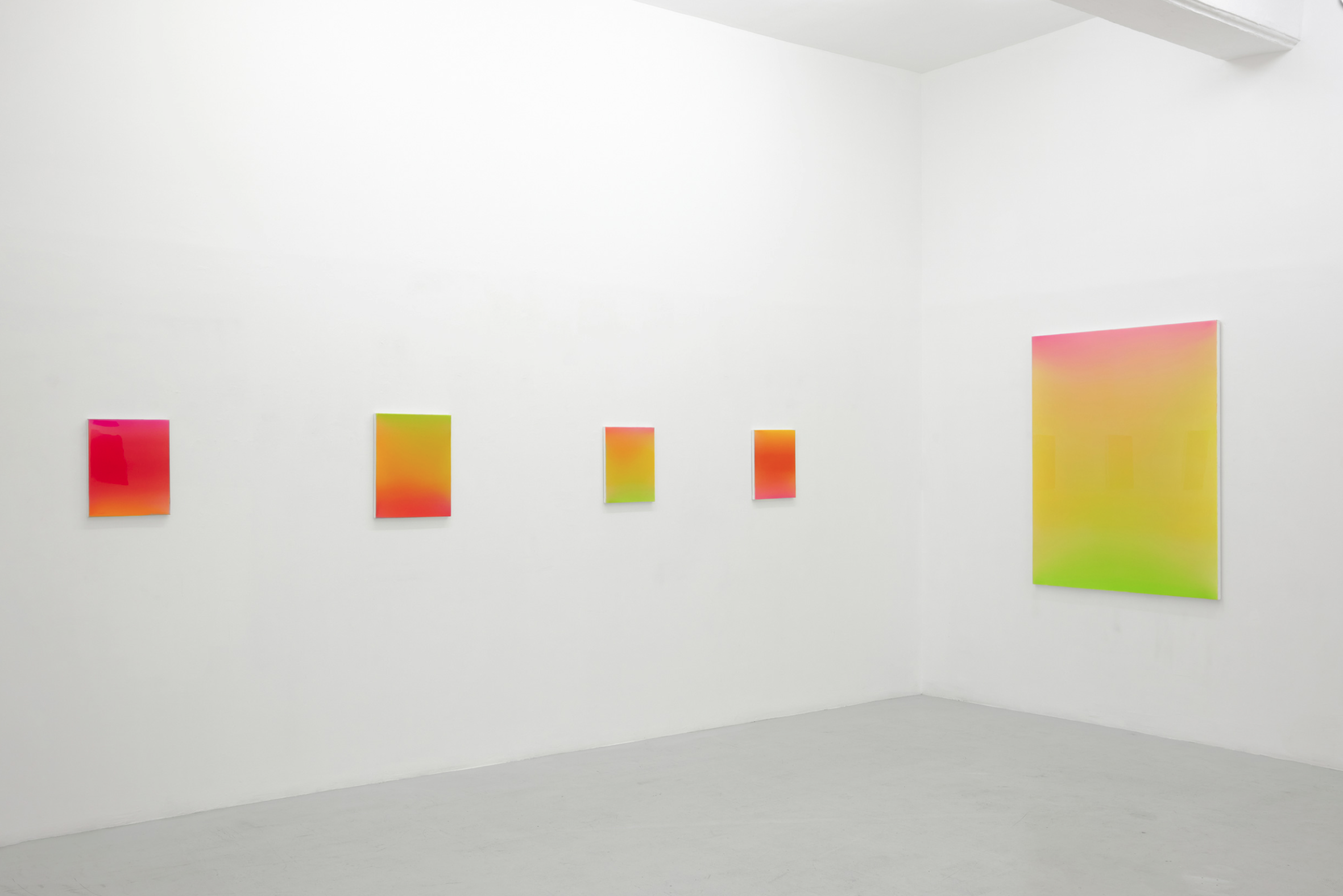
Make no mistake. Even when adorned with more acidic hues, Gilles Teboul's reflective surfaces operate in darkness. A turquoise, a salmon, a lemon? A Californian sunset? Pop introduces its shrillness. A glitch in contemplation.
A state of suspension—necessarily ambiguous.
Gilles Teboul's paintings function as contemporary vanitas. Their formal seduction, which the artist conceives as a lure, becomes a trap for the gaze. They tell me: you are here. They tell me: you are already vanishing.
I am reminded of Roland Barthes's famous "that-has-been" in Camera Lucida.
"[...] photography tells me death in the future," he writes.
Gilles Teboul's paintings have much to do with photography.
Did you know that the artist also practises it?
I mean: elsewhere than in his painting.
He has always used it in a way that might be described as conceptual.
Through photography, he inventories, archives.
It is the memory of the studio. No, not memory. Memory is too forgetful. Its record. Methodically, always following the same procedure, Gilles Teboul photographs his tools, the residue left at the bottom of his pots, failed canvases, folded canvases. Remains. Against a white, neutral, almost clinical background.
These photographs remain at the periphery.
Yet they inform the artist's practice.
They invoke this relationship to death.
Gilles Teboul's paintings have much to do with the photographic.
The presence of absence, chemistry.
For several years now, pursuing his "distancing of the painter's gesture," Gilles Teboul has been developing series of paintings in which he goes so far as to "abolish all gestural involvement" (to quote him precisely). To do so, he pours one or several coloured resins directly onto paintings laid flat on supports, without intervening in the way they spread. Gravity gradually does its work. At this stage, the pictorial layer is opaque, milky. One must wait patiently for the acrylic binder to dry before the revelation can occur.
Something expands, then sets. The image appears. Only to disappear: raised upright, exhibited, it asserts itself and withdraws in the very same movement. A mental image. Powerfully present, almost monolithic, yet paradoxically eluding apprehension: the gaze loses itself within it, simultaneously seeking and avoiding an encounter with the surrounding space and with itself. I think of the Californian Minimalists. John McCracken. On the other side of the ocean, closer to us: Art & Language, too. Michael Baldwin's Mirror Piece (1965). I think of the cinema of the 1960s and 1970s, of crime scenes glimpsed in reflections, at the edges of the plot, of complicit glass vestibules. But mentally I sweep aside all these echoes of an overwhelmingly masculine universe—one that Gilles Teboul, for his part, has been patiently deconstructing for years.
Gilles Teboul's paintings have much to do with the image.
The one that cannot be seen.
The one that obsesses, that fascinates, the one the "forbidden gaze" cannot reach—to twist Max Milner (On est prié de fermer les yeux)—the one that vitrifies, holding us at a distance while keeping us, always and irrevocably, within the field. The one that must perhaps be approached obliquely.
Gilles Teboul's paintings make me believe in their frontality, so thoroughly pictorial.
They tell me: you are the subject.
But they look at me obliquely. Where vision sharpens.
The Mystery and Misery of Painting 2026
The kind-hearted servant of whom you were jealous,And who sleeps her sleep beneath a humble lawn,We should nevertheless bring her a few flowers.Charles Baudelaire There is no idea more tenacious in France than that of the death of painting. Does this come to us solely from the avant-gardes, and from the prescriptive interpretation our public institutions may have made of them? Or does it stem...
The kind-hearted servant of whom you were jealous,
And who sleeps her sleep beneath a humble lawn,
We should nevertheless bring her a few flowers.
Charles Baudelaire
There is no idea more tenacious in France than that of the death of painting. Does this come to us solely from the avant-gardes, and from the prescriptive interpretation our public institutions may have made of them? Or does it stem from Baudelaire’s nevertheless reassuring remark to Manet—“You are only the first in the decrepitude of your art” (i.e., there is no point taking people’s mockery to heart; it will no more kill you than it did Wagner or Chateaubriand…)? One might say that, for several generations of painters, this idea has been experienced as a consummate fantasy, one that naturally called for evidence to lend it substance: a case file, experiments, personal experiences, certified testimonies.
Gilles Teboul, too, began there—by which I mean with a kind of inhibition, an impediment to devoting himself to a practice that no longer offered any vital guarantee. That was a long time ago, and one might declare the statute of limitations expired on his lament for the death of the Beautiful, were some trace of it not still present in the title of his latest exhibition at Galerie Richard: “What would we be without the help of what does not exist?” The phrase is Valéry’s. It proves that we should never despair of poets: they always manage to pull us out of the ruts into which we thought they had led us…
Teboul found his own way out, and we know how. As early as the end of the last century, taking stock of the great Catastrophe, he decided to photograph the instruments of the deceased activity. In other words, he erected his own Monument to Painting, fixing onto photosensitive paper the bottoms of paint pots and brushes, gloves, rags, canvases unstapled and taped down, dirty palettes and crushed tubes—all the discarded supports and tools strewn about the studio.¹ This distancing hit its mark, yet it was not enough to overcome a more intimate resistance.
Beginning in 2016, the artist repeated the gesture in another form. He laid his stretchers on the floor and covered them with layers of opaque resin into which he incorporated pigments: the heavy, shifting material “takes on a life of its own” across the canvases, the color sinking through the resin, the two migrating unpredictably over the more or less stable plane. Only after two days, once the resins have become transparent as they dry, do the colors emerge—pure or blended, deep or light, dense or evanescent. Depending on what appears, Teboul begins again, superimposing another layer.
The process is simple; what it reveals is far less so. For in this temporal passage from opacity to transparency, a kind of suspense arises between an initial depth and a subsequent “superficiality”; or again, as the painting moves from the horizontality of the floor to the verticality of the wall, between an unfathomable invisibility—of a bodily order—and an exclusively optical revelation.²
The self-generating process of painting that Teboul has devised lies at the juncture of these polarities of color, seeking alternately to associate it with, or dissociate it from, that which binds it—the supporting resin—or releases it: light. The sometimes numerous layers of resin create uneven thicknesses that hold back or accommodate the color. At times, pigmentary intensities efface the support altogether, producing pure monochromes—which might be compared to the flat fields of Pop Art—or even bursts of light in which the hue, already intense in itself, tips over into unreality.
In the latter case, the dazzled viewer clings to some fragment of the surrounding context glimpsed in the mirror-like painting, resisting the dissolution of the visible. The recent paintings push these contradictory tensions to their utmost: tensions born, on the one hand, of the struggle between light and color and, on the other, between color and matter.
What, then, do Gilles Teboul’s paintings confront us with? An internal strangeness. The mystery that inhabits them lies in the fact that their unity is artificial, their harmony deceptive. These are, in fact, paintings in which color stands for something seeking to escape, yet utterly unable to do so. As for the substrate, it seems undermined by some elsewhere, by an uncontrollable element that remains, again and again, the artist’s jouissance—between assurance and betrayal, proximity and absence.
Call it light, if you will, but it is the play within it and beyond it that engages the viewer—and enrages them if they refuse to admit that they have been taken in, the sorry dupe of the game.
There can be no doubt that if Teboul’s work constitutes an attempt to deconstruct painting, it cannot do so by simplifying its coordinates. The effort of letting go that one senses here is neither an idea nor a pose. With as much nerve as method, as much fascination as jubilation, he seeks to clear the table, only to encounter the impossibility of ejecting from it precisely that which refuses to adhere.
Such are these new mysteries of painting, which Gilles Teboul has fashioned, for a Sleeping Beauty, as a charming offering to Galerie Richard!
1 Roland Barthes told us that photography is the substitute for the monuments of old: it preserves evidence of the real existence of what has been. The maneuver, full of cunning, works perfectly for Gilles Teboul: the formats of his images, the angles of view, the details—everything in his photographs bears witness to that which, having lived, lives on. Variously printed, the cadavre exquis of an interrupted practice preserves traces, imprints, scratches, cuts, abstract signs: the ghost of painting survives in a kind of inverted pareidolia, the product of the imagination of a modern-day Leonardo. Teboul the photographer was, after all, still a painter.
2 Photography has led us to a dual conception of the relationship between light and color. Something like: more light = more color. Yet in painting—and this has always been so—color is subordinate to the properties of the material in which it is embedded. And since that material may diffract or absorb light, color occupies, between the two, a position one might describe as that of the "excluded third": as pigment, it is made a vassal of the materials that receive it, even if its chemistry allows it a certain freedom from whatever would seek to hold it back. For it is its marriage with rays of light that opens onto the promise of an existence of its own.
Borderless 2025
With "Borderless", Gilles Teboul continues his exploration of limits in this new exhibition. It would be wrong to see this as a militant wink: the word has at least four definitions, including, of course, that of "without limits". But isn't it counter-intuitive to link the expression to the painting, which is necessarily limited? What we need to understand is that, for the artist, and in his...
With "Borderless", Gilles Teboul continues his exploration of limits in this new exhibition. It would be wrong to see this as a militant wink: the word has at least four definitions, including, of course, that of "without limits". But isn't it counter-intuitive to link the expression to the painting, which is necessarily limited?
What we need to understand is that, for the artist, and in his practice, it's mainly the paint that makes its way onto the support; it migrates and finds its own place, without external intervention, following an uncertain path and an indefinite duration. In fact, painting is limitless in the sense that the conquest of space belongs to it. So, from limitless it becomes borderless, with no well-defined contour.
By observing these paintings, one realizes that they are not simple monochromes—an interpretation that would be far too reductive. We are not dealing with a single tone or a single value; colors shift, and the fusion between background and surface blurs boundaries, thereby disturbing our perception of chromatic limits. One only has to see. But is "seeing" the same as "looking"?
Thus, two aspects must be distinguished in Gilles Teboul's painting: the formal aspect (how it is made) and the aesthetic aspect—not in a theoretical sense, but in its etymological meaning. Aesthetics is aisthesis: literally, the faculty of perceiving through the senses, sensation itself. Teboul is therefore highly attentive to the perceptual effects of his painting. This is why the eye wanders across the surface, searching for an anchoring point it will never find, precisely because the nuances are extremely difficult to locate. One may ask: "Which color is blending here into another?" What unfolds is what might be called the chromatic enigma of transitions. It is in this sense that the term borderless should be understood: the indistinction of boundaries between what constitutes an edge, a non-edge, or an overflow. This activation of percepts is what Teboul calls "the carnal part of painting."
During its liberation—its unfolding across the support—color migrates as it occupies the available planar space. Even with a single color, variations emerge, for in Teboul's work painting is free, almost autotelic. Color peregrinates across the pictorial field, leaving no clear chromatic demarcations. Patiently, Gilles Teboul succeeds in the wager of making the infinite "hold" within the plane. Reflective and inward-looking, painting—understood here as a fluid, what the artist calls a "chemistry"—searches for its place and its outlets, finding its own combinations. In this way, painting establishes a successful paradox: that of making visible the most luminous and the most obscure—at the same time.
What is there 2022
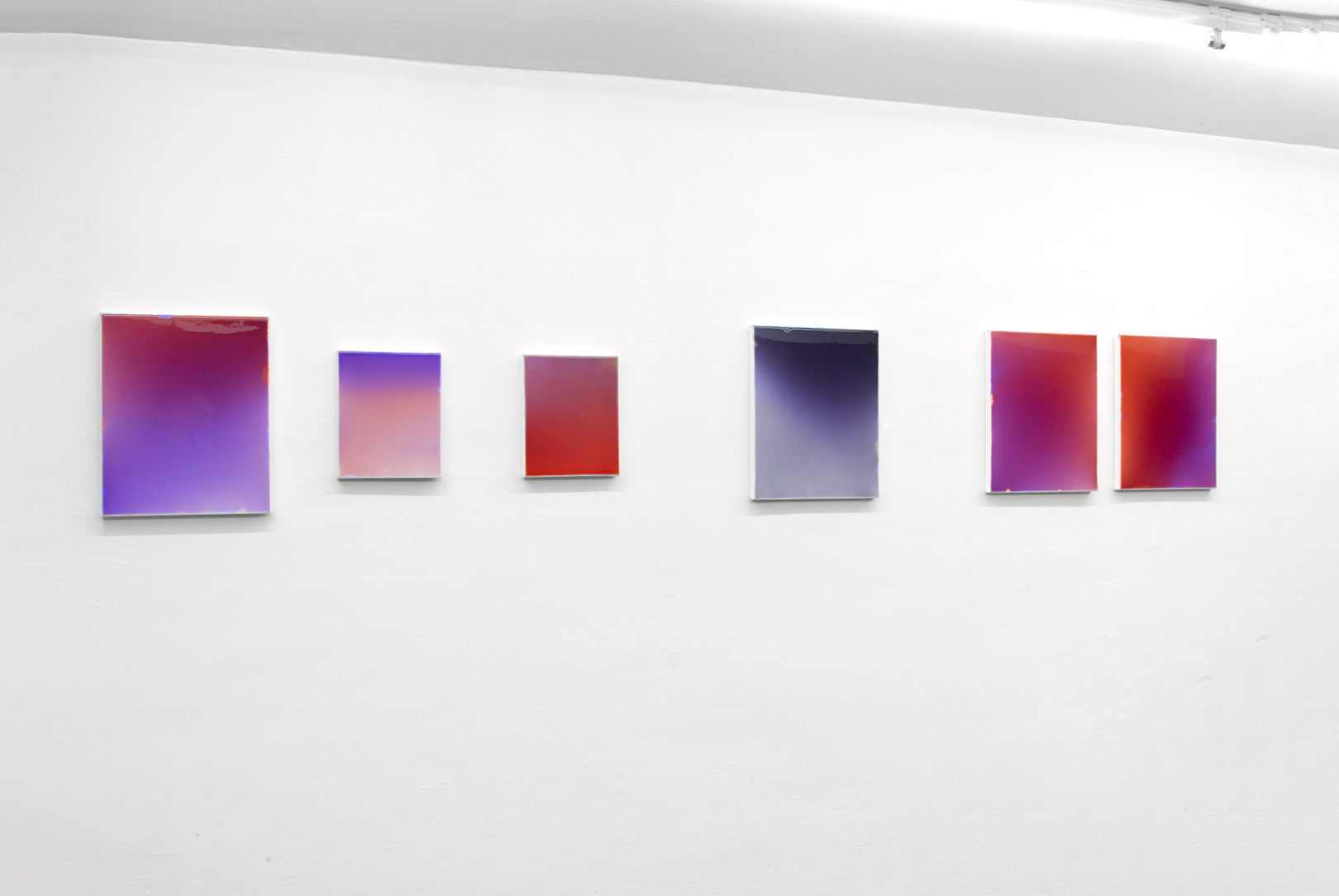
Here we see a painting whose shading evolves from top to bottom, from pink into orange. There, another pale green canvas that becomes ever more saturated. Here again, a different painting whose deep blue hue dissolves into almost blackness. There, yet another purple one, adorned with an orange ochre halo or green edges, or perhaps a barely perceptible, diffuse luminescence. Or: how does a blue...
Here we see a painting whose shading evolves from top to bottom, from pink into orange. There, another pale green canvas that becomes ever more saturated. Here again, a different painting whose deep blue hue dissolves into almost blackness. There, yet another purple one, adorned with an orange ochre halo or green edges, or perhaps a barely perceptible, diffuse luminescence. Or: how does a blue grow lighter, how does it become the brilliance of the hue itself in the most natural way possible, as if nothing has caused it, as if it emanated from the color itself. Gilles Teboul's paintings are just so, and nothing else, "her pure nails very high dedicating their onyx": a color which appears and is modulated on a restricted, framed, orthogonal surface in an opposition between the diffusion of the color that creates an unmeasured space and the limit of the painting/object that encloses and frames it – "that in oblivion closed by the frame is fixed". The painting is a limit in limitlessness, sometimes underlined by a slight whiteness at the edges, sometimes a gleam. These paintings do not question – to use a stereotypical reference from art criticism and mediation – nor do they interrogate. They are only a tonality which diffuses, migrates, absorbs light, returns it, is extinguished, or irradiates, changes according to light, asserts itself or abolishes itself. They are just colorful and luxurious phantasmagorias that only reveal what they are.
Though the painting set upon the canvas is indeed material, the spectacle it offers partially denies this materiality, just as the color appears immaterial and denies the matter which contains it. All the more so in that the resinous surface seems to place the color in an ambiguous space. From a distance, the color seems to be on the surface and behind the surface, hidden in the depths of the matter although we cannot locate it. This ambiguity between the background and the surface creates the sensation that the background rises to the surface and that the surface plunges into itself. In such a way, the painting keeps our gaze at a distance, creating distance between the material object that we imagine – the canvas ¬– and the ambiguity about what we perceive – the fantasmagoria. In this sense, the painting is both object and image, something real and unreal. A colorful object is there, dissolving itself and becoming its own image.
It is not an image of the aurora borealis, of a sunset or some other natural spectacle, nor even an equivalent, nor is it a transposition, but a colorful surface which is both itself and all the while, creating its own image of itself, here and there, both here and not there. All of this is amplified by the brilliance of the surface – "This hard, forgotten lake that haunts beneath the frost" –which, while adding a distance to the color, comes to reflect the surrounding space, or you, or me, just as the painting which may be facing it, and it accentuates the idea – first seen of the image as a reflection. The painting of Gilles Teboul is a reality and a reflection, real and reflected, and however much one gazes at it, one is reflected as much as one is drawn within, both upon and within. It is a utopia in the literal sense of the word, without location, in the absence of location – "Ghost whose pure brilliance assigns it to this place".
The object makes itself and unmakes itself, endlessly, in the act of contemplating, shifting continually between the two states, poor canvas object, of resin and pigment and absolute of its own annihilation.
What we see in this, refers to the realization of the works. Gilles Teboul has created a kind of alchemy, a mixture of resin and pigments which he sets upon the canvas spread on the floor, carefully wedged so that it as horizontal as possible. One must wait till the following day for the mixture to yield the color and its modulations and so that the painting – the pictorial object – can become visible to the painter. Even if the result is expected, the mixture, the temperature, a slight declivity, will produce an effect which is not totally predictable – be it successful or not. There is an act of deposition and a moment of revelation. The matter is deposed, material, and reveals itself materially at the same time. The color has finally emerged and fixes itself, has become surface and image. It has appeared and it is what we witness, silent and transfixed by that which is present but unnamable, it is just there.
A painting that reveals itself 2016
It was probably inevitable. For a long time, Gilles Teboul has claimed that he is seeking to put the painter’s gesture at a distance, using techniques of retreat, subtraction, what he calls the « non gesture ». By erasing, scraping off part of the matter which covers his canvases, he causes the undercoat of paint to rise to the surface.With his recent paintings, he goes as far as to abolish...
It was probably inevitable. For a long time, Gilles Teboul has claimed that he is seeking to put the painter’s gesture at a distance, using techniques of retreat, subtraction, what he calls the « non gesture ». By erasing, scraping off part of the matter which covers his canvases, he causes the undercoat of paint to rise to the surface.
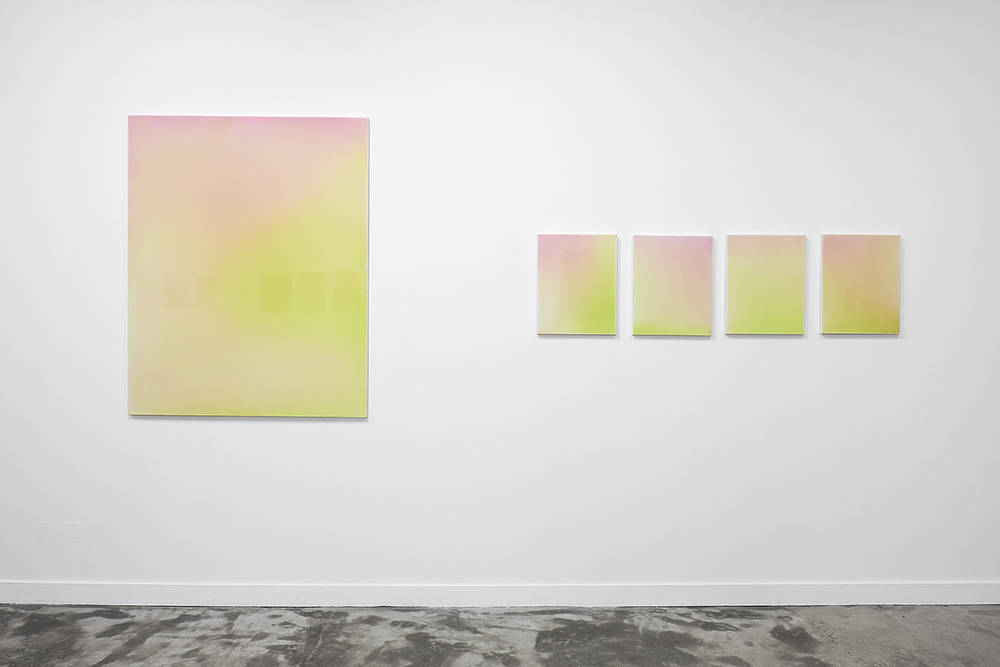
With his recent paintings, he goes as far as to abolish any gestural implication of the artist in the production. The paintings are laid flat, balanced on blocks. Teboul pours on paint which spreads over the surface without his intervening in its trajectory.
Thus, the creator’s role in this fabrication is extremely limited and the work is almost entirely created at the moment of its conception. The artist is divested of his actions and set at a distance from his realizations. In other words, the physical act of painting gives way to a procedure where color, in the purist acheiropoïetic tradition, distributes itself on the canvas. This Greek term means ‘not made by the hand of man, miraculously’.
A miracle indeed, because in general, a work is an artefact whose origin can be discovered through the study of intermediate steps, sketches, preparatory drawings, from all the work, stroke by stroke, which designates it as a human production.
In this instance, when the opaque acrylic binder used by Teboul is definitively fixed, the image jumps out and reveals itself, without unveiling the secrets of its production.
Monochromes? In appearance only, because the captivated eye discovers all the rich tonalities which vibrate under the surfaces. These translucid canvases function like an aquatic mirror in which the spectator sees his reflection emerge.
Let us be reassured though. Teboul is not a magician nor is he a mystic.
He is a painter who reveals the work done behind the scenes with a series of photographs called Peinture, which he has compiled over more than 15 years. By « recycling » his worn materials, he ressuscitates them in a way. The shots showing canvases packaged up and folded, are tangible proof that an artistic gesture, however careful and distant it holds itself, always finds its origins in matter.
Gravity 2018
Hybridation parfaite entre un miroir, un fond d'écran et une peinture post-minimale, la peinture de Gilles Teboul synthétise avec brio les avant-gardes tout en dégageant ce qu'il faut des effluves sensuelles du Pop et du Kitsch. Véritable bonbon acidulé pour l'oeil profane, l'historien des arts y verra certainement un héritier naturel de John McCracken, Dan Flavin ou encore Donald Judd.
Hybridation parfaite entre un miroir, un fond d'écran et une peinture post-minimale, la peinture de Gilles Teboul synthétise avec brio les avant-gardes tout en dégageant ce qu'il faut des effluves sensuelles du Pop et du Kitsch. Véritable bonbon acidulé pour l'oeil profane, l'historien des arts y verra certainement un héritier naturel de John McCracken, Dan Flavin ou encore Donald Judd.
S'éloignant légèrement des préoccupations de la bande de Marfa, Gilles évoque aussi bien les inventions du début du XXIème siècle en matière d'ergonomie informatique de Jonathan Ive, le célèbre designer d'Apple que celles de Francesco del Tintore concernant la nature morte et les codes de la Vanité au début du XVIIème siècle.
Ses images brillantes, carrossées, étalonnées comme des fonds d'écran OS X, dont les dégradés sensibles atténuent l'emploi des teintes fluorescentes, sont constituées de pigments liés par une résine acrylique dont le plasticien laisse imprégner la toile pendant de longues heures. Un système de cales permet à la gravité d'effectuer progressivement son oeuvre tandis que l'artiste, issu de la pratique photographique, attend patiemment l'instant T, celui de la révélation. En effet, Gilles Teboul revendique une réelle pratique d'atelier voire même de laboratoire, allant jusqu'à collaborer avec un ingénieur chimiste afin de développer sa technique si particulière.
Cette Empirie d'art est le fruit de plusieurs années de recherche, un travail qui nécessite une précision chirurgicale face à des contraintes physiques quasi indomptables.
Bien qu'inhérente à la Praxis, l'enjeu de cette nouvelle proposition du 5UN7 n'est pas la technique mais bel et bien la plasticité extrêmement généreuse de la peinture de Gilles Teboul. Les mots n'ont que trop peu de poids face au plaisir de l'oeil.
Painting in the negative 2011
Gilles Teboul uses the term ‘erasing’ when speaking of his recent paintings. It’s nothing scandalous at first glance. For a long time, negation of the form has been a constituent element of modernity. One need only evoke the famous example of Rauschenberg who, in an iconoclastic gesture, erases a drawing by de Kooning. Moreover, the nonfigurative appelation clearly indicates that contemporary...
Gilles Teboul uses the term ‘erasing’ when speaking of his recent paintings. It’s nothing scandalous at first glance. For a long time, negation of the form has been a constituent element of modernity. One need only evoke the famous example of Rauschenberg who, in an iconoclastic gesture, erases a drawing by de Kooning. Moreover, the nonfigurative appelation clearly indicates that contemporary art is crisscrossed by a constant refusal ; the same de Kooning, when speaking of artists of his generation, declares that they spend less time defining « what can be painted and more time talking about what can not be painted. ». Often, creators take the paradox to its extreme degree, making this fundamentally negating process the core of their production.
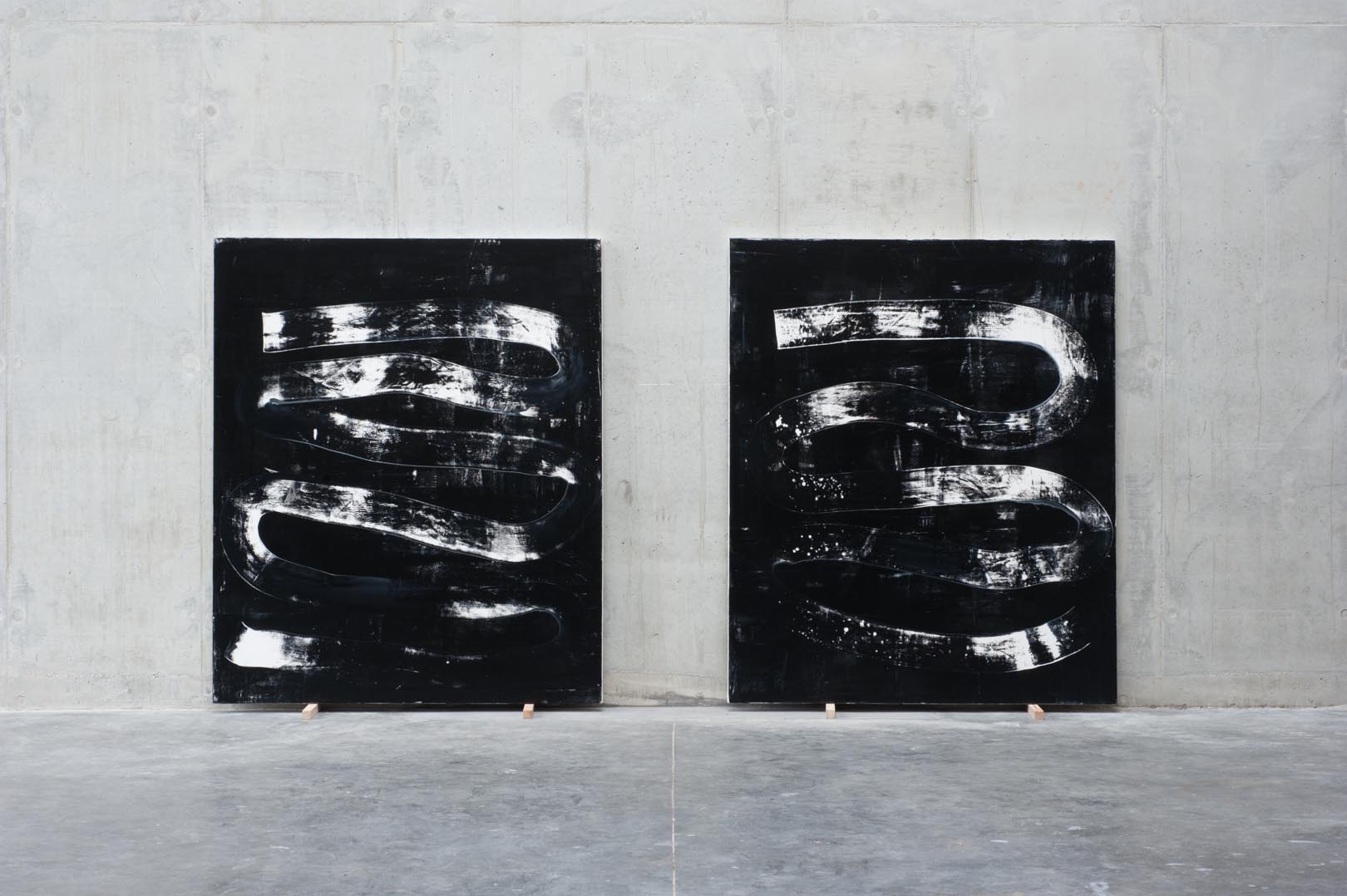
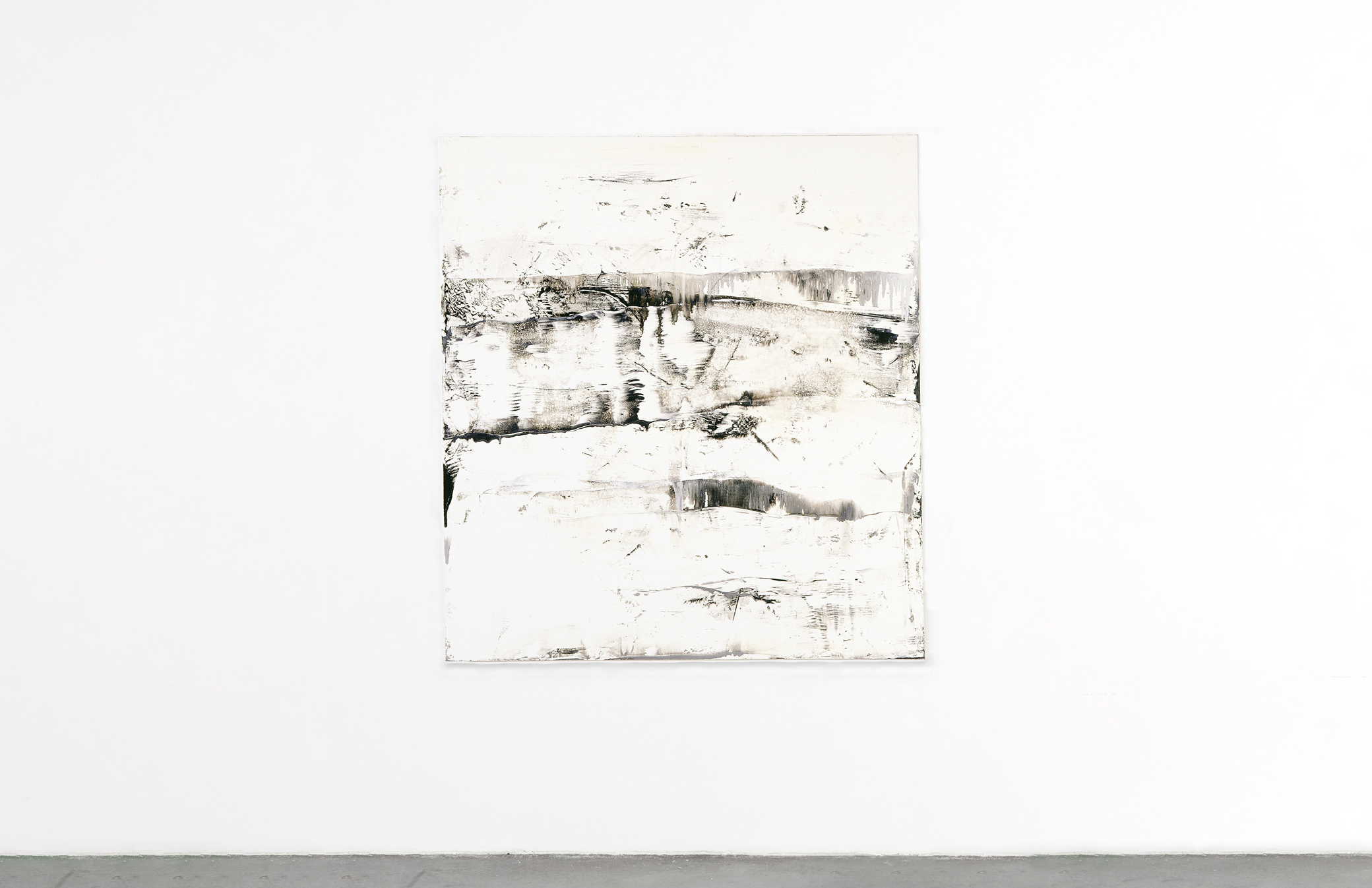
But is ‘erasing’ the real subject here? Not completely if we refer to the dictionary definition of this activity as one whose aim is to make that which was marked disappear without a trace. It is true that Teboul’s scraping technique erases the top coat of color covering the canvas, but this naked exposure creates serpentine lines which snake across the surface. In other words, the white tracks incrusted in the black background are not traced by the painting but they are its trace.
Can we thus speak about reserves? This procedure, which attained nobility with Cézanne, consists in allowing the artist to make the concealed parts of the painting appear : the preparation or the prime coat. Nonetheless, this passive componant, in counter relief, usually contents itself with a modest role, as if in retreat.
Here, everything brings us to think that Gilles Teboul is negotiating a reversal of roles ; by actively fabricating the reserve, by digging into the paint or underneath the painting, he reveals another one which becomes the true subject of the work.
The artist undoubtedly knows that in drawings with washes or waterpaints, the reserves correspond to light parts of the composition ; they are more intense than the white obtained with pigment. We then say, reserving the light. In other terms, with Gilles Teboul, by coming up to the surface level, by becoming visible, the reserve shows no more reserve.
"Painting" 2003
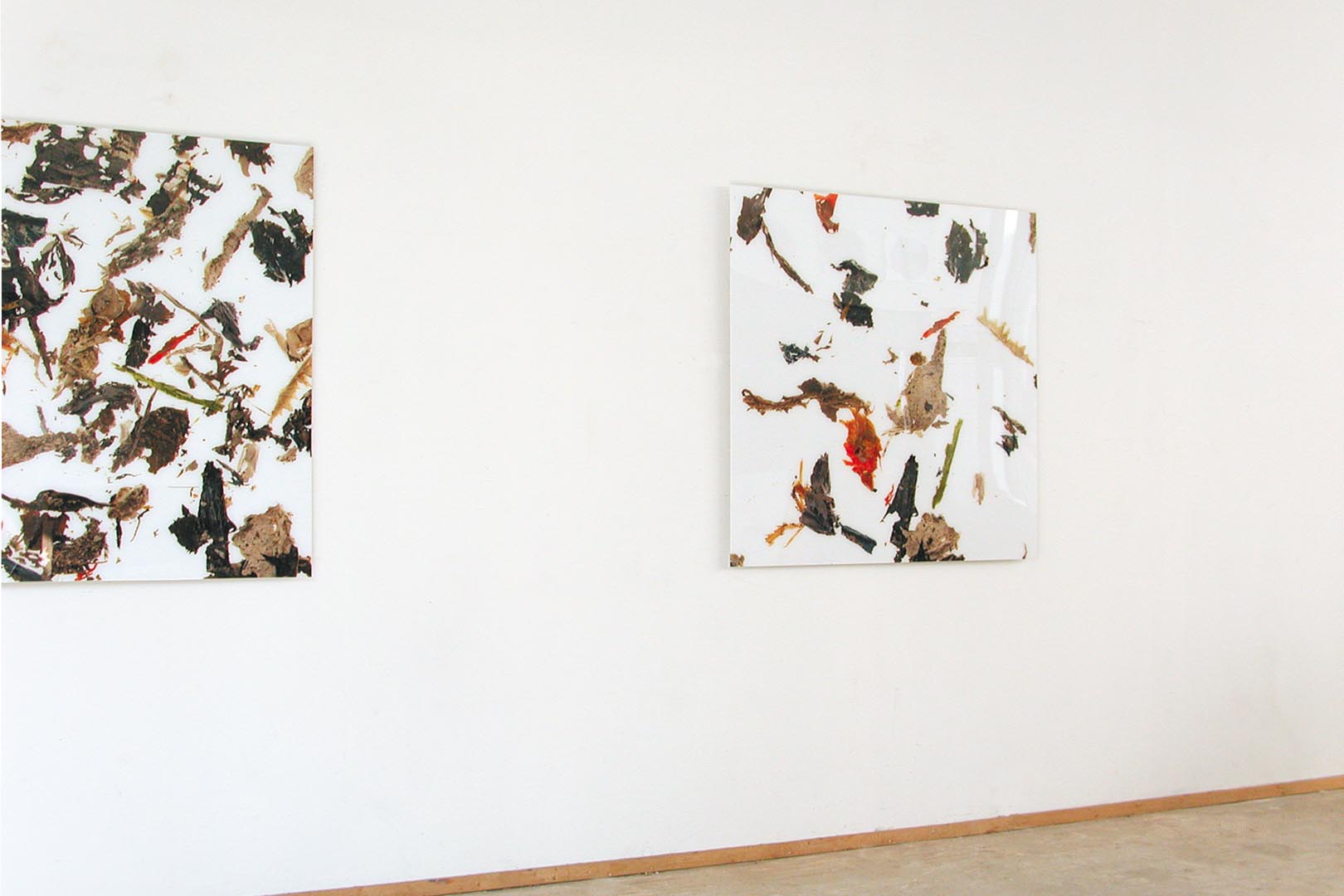
Gilles Teboul is a painter. When he takes photographs, he does so in reference to painting, in a metonymic manner. How so ? By recycling his painting materials which are worn out and dead: gloves, the bottoms of pots, paint crusts, opercula, tubes and palettes, gathered together and archived for more than ten years. What emerges are rigorous, abstract compositions, whose starkness is perfectly...
Gilles Teboul is a painter. When he takes photographs, he does so in reference to painting, in a metonymic manner. How so ? By recycling his painting materials which are worn out and dead: gloves, the bottoms of pots, paint crusts, opercula, tubes and palettes, gathered together and archived for more than ten years. What emerges are rigorous, abstract compositions, whose starkness is perfectly set off by a cold light resulting from the photographic technique... on behalf of painting. Gilles Teboul wants to take up the challenge of painting, an art which has been announced theoretically dead by institutions any number of times. Recycling has indeed become a process of resistance and renewal. This photographic series has been ironically entitled: « Painting » ...
Ironically? No, legitimately.
Painting as armed resistance 2001
Gilles Teboul is one of those artists who have taken up the challenge of painting, even though its theoretical death was often proclaimed in the last century. Resisting the most recent endeavors to set him apart, particularly institutional ones, Gilles Teboul would like to offer pictorial proof of the persistance of painting from the inside. In order to do so, he staunchly seeks to test its...
Gilles Teboul is one of those artists who have taken up the challenge of painting, even though its theoretical death was often proclaimed in the last century. Resisting the most recent endeavors to set him apart, particularly institutional ones, Gilles Teboul would like to offer pictorial proof of the persistance of painting from the inside.
In order to do so, he staunchly seeks to test its boundaries: through horizontal passageways which are a large number of furrows, almost mechanically repeated in the coats offering paradoxical blends of ivory black and titanium white, through numerous scrapings, subtractions of matter and shapes. His large canvases or his papers are the result of this erasure and they act as the revealer of this limit where painting resists. The place where all imagery becomes absent, all color neutralized – exclusive use of non colors –, all gestures eliminated, every canvas is a random state of painting in de-construction. These snapshots of painting have a carnal presence that Gilles Teboul, also a photographer, denies to photography which, even in its guise of art, still remains smooth, distant and aseptic, a prisoner of the limits of its own medium.
Moreover, when he takes photographs, it is once again in reference to painting in a metonymic way, by staging his painting tools in unexpected, abstract compositions, (the series on display at the Bruno Delarue Gallery in 2000) and ironically called, « Painting ».
Because all senses are mobilised, the painting of Gilles Teboul resists, producing an irreducible pleasure, even and especially when it is pushed to the extremes, to the limits of its own destruction.