Borderless 2025
With "Borderless", Gilles Teboul continues his exploration of limits in this new exhibition. It would be wrong to see this as a militant wink: the word has at least four definitions, including, of course, that of "without limits". But isn't it counter-intuitive to link the expression to the painting, which is necessarily limited?
What we need to understand is that, for the artist, and in his practice, it's mainly the paint that makes its way onto the support; it migrates and finds its own place, without external intervention, following an uncertain path and an indefinite duration. In fact, painting is limitless in the sense that the conquest of space belongs to it. So, from limitless it becomes borderless, with no well-defined contour.
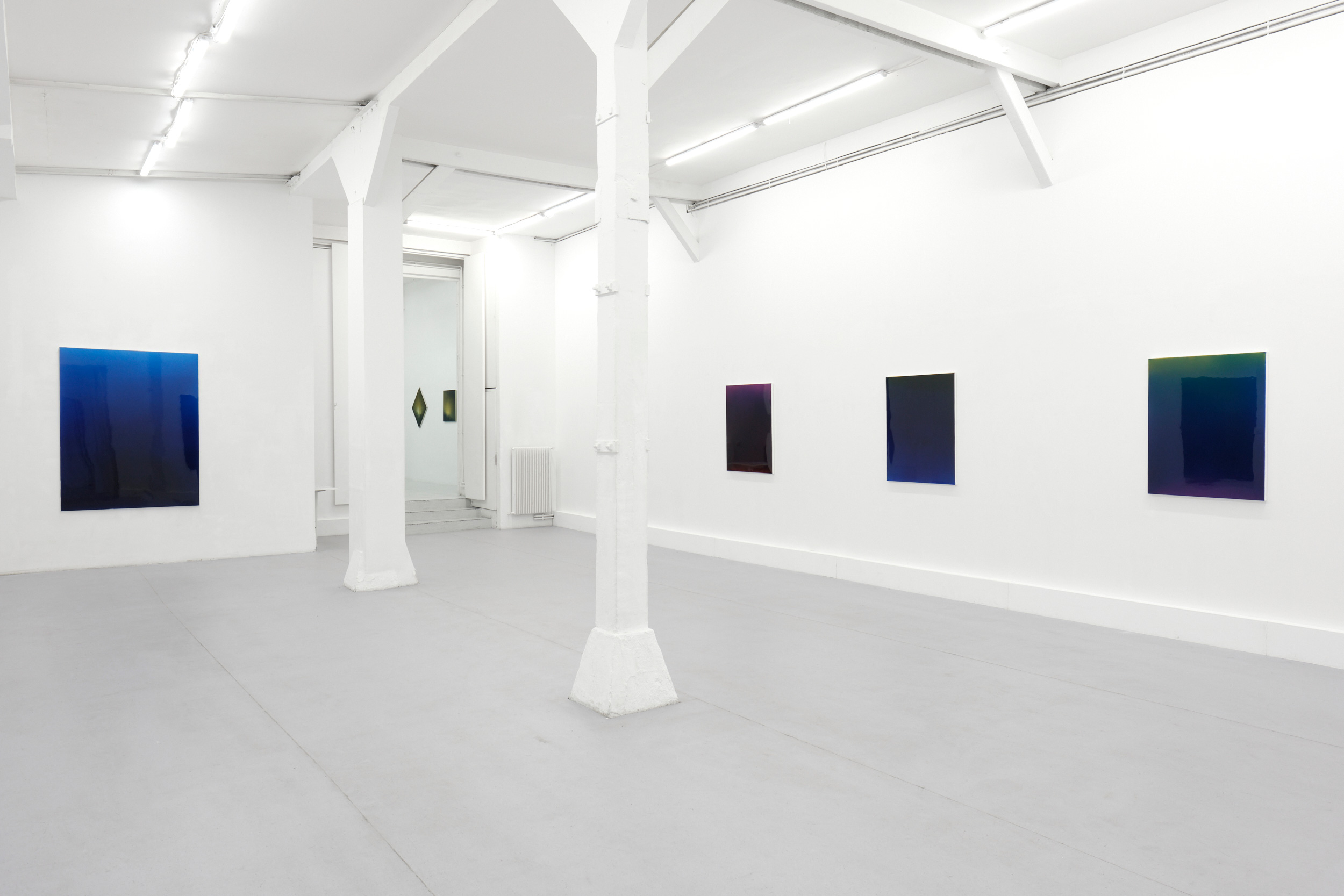
By observing these paintings, one realizes that they are not simple monochromes—an interpretation that would be far too reductive. We are not dealing with a single tone or a single value; colors shift, and the fusion between background and surface blurs boundaries, thereby disturbing our perception of chromatic limits. One only has to see. But is "seeing" the same as "looking"?
Thus, two aspects must be distinguished in Gilles Teboul's painting: the formal aspect (how it is made) and the aesthetic aspect—not in a theoretical sense, but in its etymological meaning. Aesthetics is aisthesis: literally, the faculty of perceiving through the senses, sensation itself. Teboul is therefore highly attentive to the perceptual effects of his painting. This is why the eye wanders across the surface, searching for an anchoring point it will never find, precisely because the nuances are extremely difficult to locate. One may ask: "Which color is blending here into another?" What unfolds is what might be called the chromatic enigma of transitions. It is in this sense that the term borderless should be understood: the indistinction of boundaries between what constitutes an edge, a non-edge, or an overflow. This activation of percepts is what Teboul calls "the carnal part of painting."
During its liberation—its unfolding across the support—color migrates as it occupies the available planar space. Even with a single color, variations emerge, for in Teboul's work painting is free, almost autotelic. Color peregrinates across the pictorial field, leaving no clear chromatic demarcations. Patiently, Gilles Teboul succeeds in the wager of making the infinite "hold" within the plane. Reflective and inward-looking, painting—understood here as a fluid, what the artist calls a "chemistry"—searches for its place and its outlets, finding its own combinations. In this way, painting establishes a successful paradox: that of making visible the most luminous and the most obscure—at the same time.
With "Borderless", Gilles Teboul continues his exploration of limits in this new exhibition. It would be wrong to see this as a militant wink: the word has at least four definitions, including, of course, that of "without limits". But isn't it counter-intuitive to link the expression to the painting, which is necessarily limited?
What we need to understand is that, for the artist, and in his practice, it's mainly the paint that makes its way onto the support; it migrates and finds its own place, without external intervention, following an uncertain path and an indefinite duration. In fact, painting is limitless in the sense that the conquest of space belongs to it. So, from limitless it becomes borderless, with no well-defined contour.
By observing these paintings, one realizes that they are not simple monochromes—an interpretation that would be far too reductive. We are not dealing with a single tone or a single value; colors shift, and the fusion between background and surface blurs boundaries, thereby disturbing our perception of chromatic limits. One only has to see. But is "seeing" the same as "looking"?
Thus, two aspects must be distinguished in Gilles Teboul's painting: the formal aspect (how it is made) and the aesthetic aspect—not in a theoretical sense, but in its etymological meaning. Aesthetics is aisthesis: literally, the faculty of perceiving through the senses, sensation itself. Teboul is therefore highly attentive to the perceptual effects of his painting. This is why the eye wanders across the surface, searching for an anchoring point it will never find, precisely because the nuances are extremely difficult to locate. One may ask: "Which color is blending here into another?" What unfolds is what might be called the chromatic enigma of transitions. It is in this sense that the term borderless should be understood: the indistinction of boundaries between what constitutes an edge, a non-edge, or an overflow. This activation of percepts is what Teboul calls "the carnal part of painting."
During its liberation—its unfolding across the support—color migrates as it occupies the available planar space. Even with a single color, variations emerge, for in Teboul's work painting is free, almost autotelic. Color peregrinates across the pictorial field, leaving no clear chromatic demarcations. Patiently, Gilles Teboul succeeds in the wager of making the infinite "hold" within the plane. Reflective and inward-looking, painting—understood here as a fluid, what the artist calls a "chemistry"—searches for its place and its outlets, finding its own combinations. In this way, painting establishes a successful paradox: that of making visible the most luminous and the most obscure—at the same time.